Showing posts with label internet safety. Show all posts

Wednesday, July 22, 2020

Teaching About Fake News

Since 1995, I've been saying the most critical thing we should be teaching students, is information literacy. Specifically, the ability to locate, evaluate, and use online information for problem solving. It has been 25 years of banging my head against a wall, while shouting into the wind, while swimming upstream, with one hand tied behind my back.  Yet, I keep trying, because it is the key to understanding how to handle Fake News.

I've written tens of thousand of words on the subject, most of them have probably been on Facebook.  While looking back on some of my work, I came across the Internet Library, a series of 7 books for middle school libraries back in 1998.

The problem with writing so much is you forget half of the things you wrote. It wasn't until I dug out the volume on Locating and Evaluating Information on the Internet, that I realized I had written about misinformation and the 1996 presidential campaign! Except for a half dozen links that have broken over the past two decades, everything I wrote then could have just as well been written yesterday!

If you are a teacher or parent struggling with how to teach your kids about the whole "Fake News" problem, I would like to introduce you to Web, my computer sidekick. Here, he's helping me tell a story that actually took place during the 1996 presidential election. If you click on the link below, you can download three chapters from the book and use it with your kids or your class.


Note: The books are out of print, but I retain the copyright and am making some content available for free. You can probably find some on Amazon or other sites, but I do not profit from those sales. Use should be for education. No modification or commercial use, please. 

Wednesday, January 2, 2013

How to Protect Your Privacy on Facebook

Well Facebook had made another change!  This time they "simplified" their privacy settings and in doing so, caused confusion and a new round of ill informed posts.  One that is going viral right now talks about having your friends do things to make sure the world doesn't see what you wrote.  While it isn't entirely false, following the guidelines will NOT ensure your privacy, but limit what YOU can see, thus providing a false sense of privacy.

The Snopes.com article about this is here, but they don't provide the details you need to keep yourself private. I'll go through the settings in a bit of detail, but here's the privacy picture in a nutshell. 


I can't begin to tell you how many people have lost friends, been arrested, lost jobs, college scholarships, or their jobs because the THOUGHT their post was private.

IF YOU DON'T WANT FRIENDS OF FRIENDS OR THE PUBLIC TO SEE WHAT YOU ARE DOING, DON'T DO ANYTHING ON FACEBOOK BUT READ!


Now let's take a look at what you need to do to theoretically limit your activities to your friends.  I say theoretically, because it is never as simple as it seems and there are way that your posts could be seen, especially if you are tagged on a photo and then comment, but I digress...


Now you can check and change your settings!

Below, you can see four of the five setting you should change based on you desired level of privacy.  I'll address number 2 in more detail in below.

 So far, the simplified settings are simple, but here's where it can get confusing. Clicking on "Review all your posts and things will you're tagged in" will show all your activities and, to some extent, who can see them.

When you click on it, you will be able to scroll through all your activities.  I've chosen three below to help you understand what this means and what you have to do to protect your privacy. By no means, is this a comprehensive explanation!

1) First, you see I commented on Jimmy's post.  There is no icon, before the pencil icon.  Because there is no icon there, I know that the people who see it are determined by Jimmy's privacy settings.  If he makes public posts, the world can see it.  

2) The pencil icon indicates that your settings allow this to show up on your wall.  If you don't want it on your wall, you can go to your wall and Hide it.  However, it will still be on Jimmy's page where you placed the comment.

3) The globe shows that the world can see that I "liked" Sandy's status post.  Sandy is a friend of mine who is technically sharp, has chosen to make her posts public, but lives my my motto, "Never post anything online you don't want to read in the NY Times tomorrow morning."

4) The silhouette indicates that only my friends can see this post, because I have chosen to be more private than Sandy.

So there you have it in a nutshell.  As I said, this is by no means all there is to know about privacy settings on Facebook.  Even if you NEVER post, your privacy isn't secure.  You can be tagged on photos and friends who are careless about their privacy may share things about you that you wouldn't want shared.  Not even quitting Facebook can prevent that sort of thing.

The best thing you can do is to follow the idea of not posting anything you don't want to be public and to help educate your friends.

Be safe!


Monday, April 26, 2010

I Won't Let Facebook Do It!


Yesterday I posted about Facebook's move to allow 3rd party web sites to access your data. The privacy implications were so significant that I created a presentation showing how to check your privacy settings in light of the change.

Well, I'm back today with another presentation, because something happened today that made me realize just how vulnerable we are as a result of this new change. I also realized that I missed a very important privacy setting.

The presentation explains the incident that took advantage of one of my friends and me, because of a simple oversight on my part. Here's the downloadable PDF version.

Saturday, April 24, 2010

Protect Your Privacy On (and FROM) Facebook

This week, Facebook announced that you AND your friends will now be able to share information about you with websites. Needless to say, this has huge impact on the very nature of the web and the privacy of every Facebook member.

It is causing quite a stir in the blogsphere. There are quite a few people who don't have their privacy setting secure and are already sharing too much information through and on Facebook. These people may have just had that problem compounded to the Nth degree with this latest change. Even people who are sharing things only with friends can be significantly impacted.

I've made a presentation that goes over some of the key settings you need to check to make sure your information is private and what takes place in Facebook stays in Facebook. Well, that isn't really true. Once you post something online, you lose control of it and it can go anywhere. However, there is no need to make it that much easier for you to share unwanted information with the world.

Here is a link to the presentation and if you want to download it to show to others, here is a link to a downloadable version in PDF format.

Friday, March 26, 2010

The Digital Age of Aquarius


Last night I attended a Second Life education event billed as the Digital Age of Aquarius. It was a 60's style presentation by Kevin Honeycutt (In-world:Kevinski Braveheart) It was sponsored by ISTE on Hippy Island , a fun place to explore and find hidden professional development resources.

I've been on SL for two years, but consider myself a newbie, because I never got into building or costumes. I just walked around in my standard jeans and t-shirt, which is probably more like real life than Second Life for me.

For this event you were encouraged to dress in 60's style. Fortunately, I was using the new client which offers a variety of optional clothing choices. There really wasn't anything 60's in the choices, but in the 60's I was a huge Peter, Paul, and Mary fan and my kids were raise on me playing Puff the Magic Dragon on the guitar. So I figured this choice was very dragonish, and it was as close as I would get to a 60's costume.

If you have never seen or heard Kevin before, you have to make it a point. If we could clone him, our education system would soar. His presentation was all about empowering teachers and children to use Web 2.0. Not only does he make a case for breaking down the firewalls, he does it well, by providing powerful examples of students making a difference in the world. He shows how to model and teach good cyber citizenship even if you are behind a firewall that prevents it. They are analog ways of teaching students digital skill, such as using a bulletin board, paper and pencil to simulate Twitter in the classroom. He offers good solid suggestions for professional development that empowers teachers to become digital leaders, and he even writes songs about it.

Archimedes said, "Give me a lever long enough and a fulcrum on which to place it, and I shall move the world." On his site, Kevin says, "I am a veteran teacher and a current educational technology specialist who gets up every day on a mission to help educators improve education by leveraging 21st century tools!"

First, listen to an audio file of his presentation and then visit his website. If it's a fulcrum, we can all be part of the lever that helps move the education world in the right direction.

Tuesday, February 9, 2010

Chat Roulette: A Gamble We Can Do Without!

When I first started giving Internet workshops in 1995, there were a few
sites that I used to give people a snapshot of what the web was all about. The most popular of these sites was called WebRoulette. You would click a button and be taken to a random web site.

But this post is not about WebRoulette. These sites still exist though WebRoulette has long since been bought by a casino site. Random web site generators still exist, but be careful. According to Norton Safe Search, some harbor spyware, but this post is not about spyware. It's about the 21st century version iteration of this phenomenon, Random Video Chats.

You read that right. If you go to chatroulette.com and click the start button, your web camera will start up in one window and you will be face to face with a random stranger in another.

I first heard about it in a Facebook post from Kerstein Creative that said, "The most unusual, intriguing, weird, frightening concept in social networking I've read about yet. (Can't say I've seen it, because I'm a little freaked out by it.)" and pointed to this article in the New York Magazine. http://nymag.com/news/media/63663/

After reading the article, I had to check it our for myself. The results were very much as described in the article. Here's a snapshot of what I saw. It really reflects the part of my block description that says "with great latitude given in the definition of human."

In a four minute period I saw 66 males and 7 females mostly in the teens and 20's. There were 22 connections that had their cameras blacked out and 6 "others". Others were cameras pointing at signs, walls, or other object.

The disturbing part was that of the 66 males, 6 were X-rated. There was one set of breasts displayed and unquestionably the most bizarre connection was this one.

Do I even have to say it? A web camera in the hands of an unsupervised teen, is an invitation to trouble. I understand that they might use it to talk to grandma or aunt Tillie, but do you want them talking to this guy? If your child has a web camera, at the very least, have a long talk with them!

Thursday, December 3, 2009

Time to Change Our Focus

First it was predators, then it was cyberbullying, and now it is sexting. The news media is treating us to the fear dujour. They generate reactions that are at best, narrow in focus. It's time to end this kind of narrow focus, take a step back and look at the problem differently.

When you come right down to it, the problems we are seeing stem from kids being kids in an environment that has a lack of adult oversight and guidance. When we do try to provide guidance, they often fail to respond, because they more than know we do, or at least they think they do.

WiredSafety has always know that kids will listen to kids before they will listen to adults and that they will listen to adults if we give them the credit and respect they deserve. That's why long ago, Parry Aftab established Teenangels, groups of teens who are trained by WiredSafety and law enforcement to become experts in cybersafety. We learn from them, they learn from us, and they train others in online citizenship.

The idea of online citizenship is what it is all about. There are many different kinds of online abuse, but pretty much all of them can be prevented if we create good cybercitizens.

MTV, WiredSafety, and others have been working together to empower youth to take positive action, to take ownership for their personal behavior, and be part of the solution rather than the problem. Teens will be working with teens to stay on the right side of that thin line between appropriate and in appropriate behavior at http://www.athinline.org .

Part of that effort is offering teens an opportunity to win $10,000 by coming up with innovative digital ways of stopping online abuse, as well as offering an opportunity to work with MTV and a $75,000 budget to make their idea a reality.

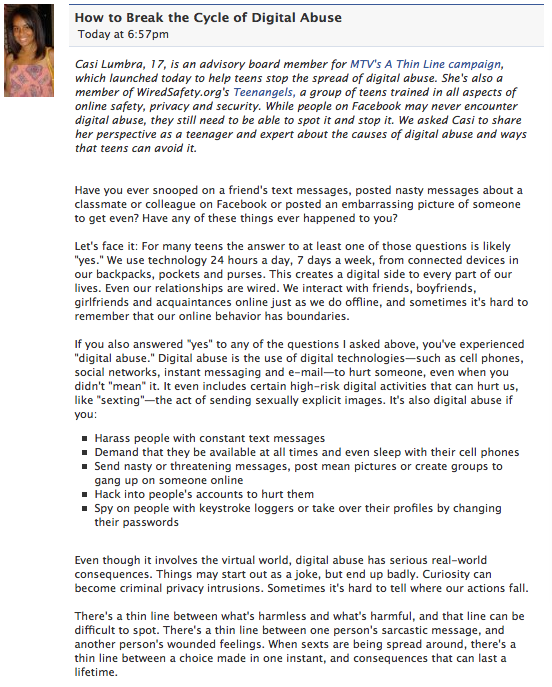
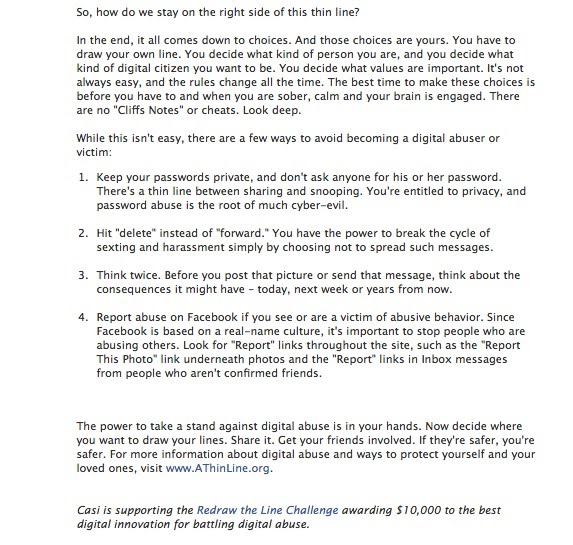
Another part is giving teens a voice and a platform to talk to other teens as done on the site and on Facebook by teens such as Casi. http://blog.facebook.com/blog.php?post=192141552130

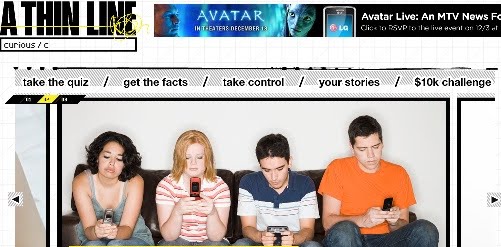
Of course, if you are reading this from school you can't visit the Facebook link. So here is the blog entry in two screen shots. Just click on each small image to expand.

Sunday, April 13, 2008

Can I Get a Doctor Here!

Ok, it's time for some no BS talk. I'll begin by making it clear
that the opinion about the state or educational technology and
Internet safety education are my opinions and not necessarily those
of WiredSafety.

Thirty-eight years ago I was a new teacher sitting in classroom with fifteen other new teachers. The then Superintendent of Rockaway Schools, Bob Linette, was conducting the class and asked us one by one what we thought of the American educational system. One by one each person sung the praises of our system. I was the last to reply and when he asked me, I said it stunk. The silence and looks on the faces of the other fourteen people said volumes.

Without pausing, he asked me to explain. I asked him and the group what part of their day was the math part, what part was the science part, what part was the social studies part? I said we were supposed to be teaching kids about life and how to success. I failed to see how this achieved that goal. I felt that school should be more like life, that kids should be solving real world problem and doing real world work. When I was done, he just said, "You're absolutely right."

Those three words set the course of my career and from that day on, I never looked back. Ever since then I've been trying to get schools to change the way they deliver instruction. It's thirty-eight years later and things have changed very little. Yes, technology is now in the picture, but technology implementation without changing how we deliver instruction is not going to work. In many ways technology has worsened the situation. There was already disconnect between curriculum and the skills that the 20th and 21st century required. With kids knowing more about technology than the teachers, the gap became a chasm.

As a result, the state of educational technology infusion in this country is a shambles. I'm not talking about the cables, routers, and computers. They are nothing to brag about, but compared to the hardware, the effective implementation of technology is in such a state that if it was in an episode of M.A.S.H., it would be on a gurney, with Hawkey and BJ doing everything they can do to keep it alive as it was heading for the operating room.

Lack of visionary leadership, lack of technical support, lack of professional development, budget constraints, NCLB, pressure to perform on high stakes tests that measure all the wrong things, and other mandates that hamstring teachers, make them little more than paper shufflers and test tutors. Yes, there are pockets of excellence. There are exemplary schools and programs, and there success stories, but they are the exception rather than the rule.

I've spent the last ten years of my life trying to make a difference in this arena. Now I've retired from that life and have perhaps jumped from the frying pan into the fire. I'm attempting to develop Internet safety instruction that schools can use.

If you believe what I say about the state of educational technology in this country, then it isn't a stretch to realize that the state of Internet safety education is in worse shape. If teachers don't have the time or expertise to implement effective use of technology in the core curriculum, expecting them to implement Internet Safety instruction is total folly. It's like strapping a couch to the back of a sprinter and asking him to run a marathon.

I'm not sure if it's because I'm an optimistic masochist or because I graduated from Rube Goldberg High School and McGuyver High School, but I liked the challenge. Two years ago I started a program that I felt dealt with both problems at the same time. I coined the phrase
and began my program of CyberSafety through Information Literacy. It was a series of lessons that could serve both as professional development for teachers and Internet safety instruction for students. The lessons are aligned to the National EducationTechnology Standards and other core curriculum standards. Instead of being add-on curriculum, it could be integrated into the existing curriculum in a number of ways.

Inexperienced teachers could run the Flash based lessons and let me provide the instruction. Because the software allows teachers to control all phases of the presentation, including sound and sequence, as inexperienced teacher became more comfortable with the material,
they could make it their own by substituting their narrative for my audio tack and by selecting what to present and when to present it.

Now I think it's time to take the next logical step. We at WiredSafety have found that two of the most effective tools for getting teens to listen to our message is to have it delivered by other teens and to have the message wrapped around real stories about real people and real events. Our Teenangels have stories of their own that they relate. You can find out more about them by visiting Teenangels.org.

We at WiredSafety have stories activities and suggestions that we relate to parents, teachers, and teens in our presentations. Some of those stories are already contained in my CyberSafety through Information Literacy lessons. Over the coming weeks and months, I'm going to begin extracting those stories, add new ones, offer short suggested actions and activities, and create a library of 5-10 minute learning objects that teachers and parents can use whenever they have
time or whenever they see a teachable moment.

I'll blog about them here and post them on the WiredSafety site. As they begin appearing, I welcome your comments, questions, and suggestions.

Maybe together we can help Hawkeye and BJ get a patient off the critical list.