Showing posts with label education. Show all posts

Saturday, September 5, 2020

Truth, Lies, Rumors, and Rumbles

The sacrifices and hardships endured by those who choose to serve are something most of us will never understand, but all of us should honor and cherish them. In keeping with my pledge to give thoughtful posts, I'll refrain from editorializing and offer this post in the hope it will help someone in some small way.

Today, on Facebook, Mess Wright said,  "My dad was a Vietnam vet who had some issues as a result. I got to grow up dealing with that. One brother served in combat in Kosovo and is totally traumatized from that. Another brother killed himself in his driveway after serving in Iraq and Afghanistan. Trump calling dead vets losers is not surprising but it’s just one more way he beats up decent people who have served the USA in ways his accidental presidency never has and never will. I’ll never understand those of you who still support him, and I never will. I want you all out of my life for now and forever." 

----------------------------------------------------

Her story, like many others, brought to mind my Uncle Harold. He was a WWII vet, but didn't speak about it much. One day, when I was about 12, I asked him what he did in the Army.  I didn't go into detail, but he told me of being stationed in Germany and of an anonymous poem pinned on the barracks bulletin board and the impact it made on him.

I sat transfixed as he recited it. It made such an impression on me, I asked him to write it down, and I memorized it that same day. Over the past 60+ years, the more I learned about the war, the more I realized, how much that poem said about his time overseas.  I have shared it with others hundreds of times and recited it in my mind thousands of times, but one time will live forever in my memory.

Back in the mid-90s, our teachers and administrators were in a battle with a board of education who ran the school district much like the country is current administration is running the country.  They had two agendas, neither of which had students in mind. In their efforts to implement them, the district suffered considerably. One was to get rid of the superintendent and the other was to cut spending as much as they could.  They started on the later as soon as they had the majority.  Sometime later, the superintendent resigned for the good of the district.  

The new superintendent, while not a puppet, was powerless to fight their decisions. Lies, backroom deals, cronyism, bullying, firings, transfers, and control of local media were their tools. If a teacher or administrator opposed them, they were called to task, fired, or transferred. After a year or more of this, I decided to use the internet to get the truth out, because I felt it was a tool that could make a difference. I created Truth, Lies, Rumors, and Rumbles.

Over a 6 month period, my battle became public as newspapers began getting wind of it a teacher taking on the board on the web. The battle was no longer local as my website won a Point 5% award in the education category and the Electronic Freedom Foundation offered legal help. I thanked the EFF and told them I would let them know if I needed any.  

I had a habit of fighting city hall, and as they say, this wasn't my first rodeo. More importantly, I had the advice of one of the top attorneys in the country, who just happened to be my first cousin. Before I began, I contacted him, told him I was going to take on the board, and knew they would come after my job at some point.  He told me exactly what to do and as things turned out, his advice was golden. 
   
When they eventually did come after me, it was a surprise attack. It happened one night at a televised board meeting. The meeting was almost over.  They had just come out of a non-public session. After getting up to make a comment, they attacked me. I couldn't believe what they were doing, because it violated state law, our contract, and more, which you will soon see. As it was happening, I couldn't believe it, but then as looked at the table and realized the board attorney who was a regular fixture at EVERY meeting, wasn't there to stop them as he had in other instances when they were getting ready to cross a line. I later found out as they came out of non-public, the board president told him he could go home, because there was only 5 minutes left in the meeting.  As it turned out, those 5 minutes were arguably the most important 5 minutes in the meeting. It became the next episode of As the Board Churns.

It was at that point I decided to get the state teacher association's legal department involved. Our first and only meeting was held on the morning of the next board meeting. After I filled the attorney in on what had transpired over the past 5 months, he asked if I had any documentation. I could hear it in his tone and see it in his body language, he had heard it before.  I knew he wasn't expecting the three ring binder filled with about 250 pages of notes, letters, newspaper clipping, and more.  His eyes lit up like a kid at Christmas.

As we continued, I asked what our next step should be, because the next board meeting was that night (Tuesday). He told me I had two choices.
1) I could sit in the audience and say nothing, and if they took any action against me, he would file in federal court by Thursday for violating my civil rights.  2) I could go in front of the board and say whatever I like, and if they took any action against me, he would file in federal court by Thursday for violating my civil rights.  I opted for number 2.

That night, as I stepped up to the podium, I saw the board attorney say something to the president. I began about a 10 minute speech that refuted everything they said during their attack on me, and then gave them a bit of their own medicine.  If looks could kill, I would have been struck dead on the spot. At one point, the VP was getting ready to say something when the attorney to put his hand his shoulder and just nodded his head, no  . It was obvious the attorney had updated them on how badly they had screwed up in the 5 minutes he was not at the previous meeting, because they never said a word.  I really don't remember what I said in the speech, or how I made the transition to the poem, but I can still see their faces every time I recite it.

I have hoped. I have planned. I have striven.
To the will I have added the deed;
All that is in me I've given
In the hope that I would succeed.

I have dared and reached only disaster,
I have battled and broken my lance;
I am struck by a pitiless master
That the weak and the timid call Chance.

I am old. I am bent. I've been cheated
Of all that youth urged me to win;
But name me not with the defeated,
For tomorrow, again I begin.

Prologue:
Shortly after that, I reached out to LM_NET, the Internet's largest mailing list of librarians, to try to find out who wrote the poem. They came through in flying colors.  The poem was titled, Unsubdued, and was written by S.E. Kiser. The version above, is how my uncle remembered it. The S.E. Kiser version had only a few words different, but the changes provide a powerful picture in to the mind of the GI who posted it on the bulletin board, but that's another discussion.

Things came to a head with the board as we approached the April elections. Three of the members' terms were expiring.  Two of them had decided not to run, but the president was up for re-election. On TLR&R, I said that on the day after the election, if the president was re-elected, I would take that as a message from the public, and would resign my teaching position. In his campaign literature, the board president said he was elected to the board by one of the largest margins in township history, and trusted that the voters would return him to the board.  When the results came in he was defeated by one of the largest margins ever.

The truth is a powerful thing!

Wednesday, July 22, 2020

Teaching About Fake News

Since 1995, I've been saying the most critical thing we should be teaching students, is information literacy. Specifically, the ability to locate, evaluate, and use online information for problem solving. It has been 25 years of banging my head against a wall, while shouting into the wind, while swimming upstream, with one hand tied behind my back.  Yet, I keep trying, because it is the key to understanding how to handle Fake News.

I've written tens of thousand of words on the subject, most of them have probably been on Facebook.  While looking back on some of my work, I came across the Internet Library, a series of 7 books for middle school libraries back in 1998.

The problem with writing so much is you forget half of the things you wrote. It wasn't until I dug out the volume on Locating and Evaluating Information on the Internet, that I realized I had written about misinformation and the 1996 presidential campaign! Except for a half dozen links that have broken over the past two decades, everything I wrote then could have just as well been written yesterday!

If you are a teacher or parent struggling with how to teach your kids about the whole "Fake News" problem, I would like to introduce you to Web, my computer sidekick. Here, he's helping me tell a story that actually took place during the 1996 presidential election. If you click on the link below, you can download three chapters from the book and use it with your kids or your class.


Note: The books are out of print, but I retain the copyright and am making some content available for free. You can probably find some on Amazon or other sites, but I do not profit from those sales. Use should be for education. No modification or commercial use, please. 

Thursday, April 16, 2020

Did I Find Bernie Dodge's Senior Picture?

The fact that I'm writing this is testament to the cabin fever of Covid 19 social distancing. The fact that you are reading it confirms your situation as well.

I just came here from Facebook, where I was going to reply to the post from Bernie Dodge on the left. It set off a bizarre chain of events that just couldn't be typed as a Reply, mainly because I'm incapable of writing a long post inside FB without accidentally posting it 15 times before I finish typing.

I'm giving the Reader's Digest version, because the chain of events continues beyond the topic of this post. The full version is something for a much longer post or series of posts that will put most people to sleep, but may be of interest to a few.

By now you have read Bernie's post. When I read it, something clicked and my mind went back to an unsolved mystery from the late 90's. It took place on the K-12 Admin mailing list. A debate was taking place about the nature of schools and change between the Sages on the Stage and the Guides on the Side crowds. Then along came Ditherhead.

Ditherhead was definitely aligned with the Guides on the Side. He was an in your face kinda member who came out of nowhere. His opinions were not take well by the Sages, but what bothered them most was the fact he didn't identify himself in any way.  They demanded to know who he was, but he never said.

The debate became more heated, not about school change, but about Ditherhead's anonymity and his lack of respect for their opinions and PhD's in their signature lines. Ditherhead was relentless in putting forth his vision of schools, and the Sages were relentless in their attacks on him.

Then things took a turn for the better or worse, depending on your perspective. Ditherhead began toying with them about his identity.  One day, in response to the demands that Ditherhead reveal himself he said that he wouldn't say who he was, but would post a picture of himself.


IS THIS BERNIE DODGE'S SENIOR PICTURE?

Note: There is much more to the chain of events that unraveled as a result of Bernie's post. I've heard nothing from Ditherhead in more than 20 years, but I have run into this photo in context of my work, including an interesting discussion with an FBI agent and his familiarity with it, my first meeting with Tom March, the discovery of a long lost video, and a 9 year search for a decent haircut in NH, but those are all stories for another day.

Monday, February 5, 2018

The American School System Stinks!

It was 1970, and I was one of 15 teachers sitting in a large circle in the faculty room at Fairleigh-Dickinson University. Superintendent Bob Linette of Rockaway township was our professor. After asking up what we thought of the American educational system, one by one, he asked us to respond. I was the last to answer. After hearing 14 people sing the praised of our system, he said, "Mr. Wolinsky?"

I swallowed hard and said, "I think it stinks.."  The collective gasp in the room was audible.  Bob's response was to ask me to explain. I said that we were supposed to be preparing students for life, but we weren't teaching life skills. Life wasn't broken down into 1 hour subjects. The was no math part of my day, not science part, no social studies part. Life is problem solving, communication, and collaboration, but none of those things were what school was about.

His response was simple. He said, "You're absolutely right." Those few minutes validated what I felt throughout my high school and college years, and formed the based of my work for the next forty years. From that day on, I taught to give the kids what they needed and deserved, rather than what the system dictated and worked to try to change the system.

That often put me at odds with my colleagues and administrators. In my early days, I got the reputation as a radical nut, but 20 years later I found myself, like Bob Linette, working with teachers who were entering education. During one workshop a teacher asked me how I made the switch from the sage on the stage to the guide on the side. I told her I never made the change, because I never changed. The only thing that changed was the label. I was teaching that way since 1970.  The only difference was that back then I was a radical nut, and the previous week someone had called me a visionary.

Fast forward to 2018, and the pendulum of change is swinging slowly. There is no denying that the skills needed for today's world are at odds with the form and function of many or our schools, but change is often painfully slow! It only took 50 years for the chalkboard to go from prototype to common place, and 25 year for the overhead projector to make it from the bowling alley to the classroom.

Many schools are recognizing the importance of communication, collaboration, problem solving and project based learning.  This video is actually from India, it is just one of any number of countries who are moving toward 21st century education faster than we are.


Next Saturday, here in Raymond, New Hampshire, citizens have a chance to weigh in on the school budget at the 10:00 AM deliberative session. I know for a fact that people will be there arguing that the budget needs to be cut. While I support the budget, I completely understand their desire to keep taxes down, I am a serious odds with some of the rationale for doing that. They will point to graduation rates and test scores, but neither is indicative of what it going on in our schools.

Remember, change is slow. Over the past 5 years or so, our schools have been changing from teacher delivered instruction to problem and project based learning that develops the competencies needed for 21st century life. Evaluation is changing from one size fits all numeric and bubble sheet testing, to competency based assessment, that measures internalized skills rather than arbitrary memorized facts.

We have a new superintendent, a new curriculum director, and a new technology director.  All of them are well versed and committed to the necessary change, but as a community we need to support that change and give it time to take hold. 

I implore those who are concerned with taxes AND education, to learn more about school change and how it is being implemented and do whatever you can to support that change.  On of my contentions is that we are being held hostage by a multi-billion dollar testing industry that is hold us back, because it the kind of assessment needed for the 21st century is bad for their bottom line.

Einstein said, "Everyone is a genius. But if you judge a fish by its ability to climb a tree, it will live its whole life believing that it is stupid."

Tuesday, February 21, 2017

Digging for Digital Gold

A few hours ago, my grandson and I were sitting on the floor examining the contents of my Rube Goldberg box.  It's literally a collection of junk that I've collected over the years.  I figured he was at the age where he could have some fun with it.

As it turns out we BOTH did.  I came across an old 4.0 megapixel camera.  We threw some batteries in it and found that worked. Unfortunately, it had a strange USB connection for which I didn't have a cable.  I told him there was no way to get the pictures off.

I got up to answer a text that had just come in and while I was texting, he was exploring the camera.  The next thing I heard was, "What's this, Pop-pop?" I turned around to see him holding an SD card that I had overlooked.

I put it in my computer and found digital gold.  There were pictures still on it from 2005!  Some were of projects from students at Southern Regional Middle School and some were pictures from students at the MLK Elementary School in Atlantic City.

The pictures brought back a flood of memories of projects, which back then were ground breaking. The ones from Southern Regional were part of a cross curricular unit in which the entire school participated.  The theme that year was Egypt.  Teachers throughout the school designed and shared lesson plans around that theme.  The energy in school was electric and the unit culminated in the school stage being turned into an Egyptian museum complete with about two tons of sand.

These are a few of about two dozen pyramids made by students as part of one of the math lessons during the project.


The Atlantic City pictures were even more exciting and what's more amazing is that I was talking about this project with my grandson three days before he found them on the camera!

In 2005, I was mentoring 3rd grade teachers to help them integrate technology into the curriculum. During the summer of 2005, Andy Carvin had given us a three day workshop on film making. As part of that July workshop we created what we believe was one of, if not THE first elementary school video blogs, called Atlantic City Rough Cuts.

In September, I introduced them to a digital story telling software called Kartouche. By November  Janine Riggins and her third graders were using Andy's lessons and Kartouche to create products shown in the video below.


Digital gold!

Sunday, February 12, 2017

Teaching with FLASH!

As a kid, growing up on the farm, Superman, Batman, Wonder Woman, Green Lantern, Aquaman, and The Flash, and other DC comic heroes were my companions. Along with my father and mother, they were role models who reinforced the values he instilled in us.

Comics and the life lessons within them were literally and figuratively in the classroom with me  throughout forty years of teaching and professional development until I retired in 2012, but In 2017, little has changed. I still enjoy comics in the form of movies and TV shows, and the lessons continue.

Today, during while watching the latest episode of Flash, in a single paragraph, the he put into words, something the every good teacher understands either intuitively, or as a result of great examples.  It's been something I've been trying to do through 25 years in the classroom and 15 years of professional development.  If said it in many different ways, but today, the Flash summed it up in a single, elegant paragraph that cuts to the heart of teaching and learning.

Flash and his protege, Kid Flash, were trying to work through problems in Kid Flash's training. Kid Flash had recently failed at an attempt to save someone, and lamented, "You're telling me everything that I need to learn. I'm just not getting it! I..."
 
Flash interrupted with, "No, that's not it.  I've been letting you coast by on your own raw talent, which you have a lot of, but teaching is a lot more than just doing something and expecting you to follow.  It's about inspiring you and empowering you to use your gifts to succeed on your own.  That's what I need to do.  That's what I'm going to do from now on, so that next time you are out there on your own, you will win."

What more needs to be said?

Saturday, December 8, 2012

Online Communications and Asbestos Suits

I began my online life in 1980, long before the Internet. Chat rooms and discussion forums were available on computer bulletin boards that were accessed via dial-up modems. Over the years, I've administered dozens of Internet mailing list, web forums, online classes and just about any type on interaction that takes place online.

While there is a great range in the way the technology delivers the communications, there is one constant, namely the human one. When people first get online, they don't understand that online communication is different from face to face. The impact of the written word doesn't always convey the sentiment or intent of the words. Thus, the internet has its own set of standards know as  Netiquette .  Each mailing list, discussion forum, or online community has its own special set of rules that fall under the Netiquette umbrella. 

The lack of understanding of newbies can lead to all kinds of problems. My view of netiquette is a little like my view of etiquette. I really don't care if you use your salad fork for the main course of if you sit with your elbows on the table. I overlook the little things. On the other hand, I don't want to see you lick soup out of the bowl or pick your nose at the dinner table.

 I wager that everyone reading this has, at one time or another seen or been involved in a Flame War. Flame wars can destroy a group or make them stronger, depending on how they are resolved. As I said, I was online in 1980. Getting online then meant you had to be a geek. When you came online you were known as a newbie. It was, and still is wise for a newbie to lurk before posting.

Unfortunately, some people just don't get it. Flame wars broke out shortly after the first modem went online. Sometimes is was because some people don't care, sometimes it was the result of a newbie mistake mistake such as breaching a serious point of netiquette or posting a private message to a public forum. Then again, some people are natural born trolls and love the flames. They are like Internet pyromaniacs.

As an online administrator, I've witnessed 100's flame wars and mediated more than my share. In the early 90's CompuServe and AOL, both closed communities, opened the Internet flood gates by giving thousands of netiquette ignorant newbies access to the Internet. It was the electronic version of Smokey the Bear's worst nightmare. Everywhere you turned another conversation thread would burst into flames.

That same year, I began doing volunteer work for WiredSafety.org and began actively trying to educate others about netiquette and online safety. I was also the leader of a group of folks who created the first Internet online tutorial specifically aimed at teachers and students.  While it is considerably, because technology has changed so dramatically, except for one broken link that can be replaced by this one, the section on netiquette remains viable, because it deals with the way people should conduct themselves online.

1) Once you post something, you lose control of it. Whether it is a comment or a picture, anyone receiving it can grab it and do with it as they please
2) Think before you click. If you send a rant about the boss to a co-worker, make sure it is going to your co-worker, not the company mailing list.
3) Never post ANYTHING online that you don't want to read in the New York Times on Monday morning.

That doesn't mean you can't express your opinions about your boss strongly. You can still do so effectively.  You might tell you friend your boss is inconsiderate and ill informed rather than calling him a %$%&# idiot. That way, if your private email does make it's way to the boss, instead of getting fired on the spot it might lead to a rational conversation between you and your boss.  Or not...

Friday, October 21, 2011

My Way or the Highway

Back in the 80's, I was teaching 9th grade general math. In the back of the class sat Scott Harris (name changed for privacy). His body language and facial expression mirrored what I had been told, namely that he was just waiting until he was 16 so he could drop out of school.

One day, as I showing some new skills and and the method for solving the problem, his expression soured and his head shook in disagreement.

Puzzled by his actions, I said, "Scott, what's up?"

Frowning, he mumbled, "Nothin..."

"It must be something or you wouldn't have made a face. Come on. What is it?"

We went back and forth like this for a little while until he finally relented and said, "That's not the way I do it."

"OK, show me how you do it."

"Why? Teachers never let me do it my way. I have to do it the way they do it."

"Well, that's not the way I work. If your way works, I have no problem with it."

Still with a look of disdain on his face, he came up to the board and showed me a method I had never seen. We did a half a dozen problems and every one of them came right. Try as I might, I could not come up with a problem that couldn't be solved using his method.

I said, "That"s cool! As long as it works, you can use your method." I though I saw a glimmer of a smile as he went back to his seat.

He did well on the quiz and we moved on to the next skill. After I showed the class how the problem was solved, I turned to see Scott shaking his head again. When I asked him about it, he once again said, "That's not the way I do it."

We repeated the same scene from the week before and to make a long story short, it was repeated many more times during the year.  In fact, after about the third time, I had an assistant teacher in the class. I would show the class how to solve the problem and then invite Scott up to the board to show us the "Harris method".

He thrived in my class, but unfortunately, as far as the system and his previous teachers were concerned, Scott was a failure. I believe that Scott was actually a math genius and prior teachers didn't meet his needs. He certainly had a far greater grasp on math relationships than I did. I couldn't help but wonder whether his gift (or curse) extended to other subjects.

I wish I had a happy ending to this story, but Scott was turning 16 before the next school year and had already determined he was quitting. Scott had not failed. The system had failed him.

I don't know where Scott is today, but I hope that like so many geniuses before him who were failed by the system or terrible teachers, that he is thriving, sitting in some office as a CEO, and doing things via the Harris method.

Saturday, September 3, 2011

It Really Stinks!

I started teaching in 1969 on an emergency certificate. I was a liberal arts major with no teaching courses under my belt. In order to get my permanent certificate, I had to go through the paper chase and take the necessary courses.

Of course one of those courses was supervised teaching (practice teach for those who are already teaching). I would be observed twice a week and once every two weeks, all of the teachers in the program would meet for a three hour group session at Farleigh Dickenson.

The teacher for that course was Bob Linette, then the Superintendent of Rockaway schools. I never met him before or after completing the class, yet I will remember his name until the day I die, because three words from him on our first day of class, confirmed my beliefs and helped set the direction of my teaching for the next four decades.

There we were about 15 of us seated in a circle. He posed a question. I was seated on his right and one by one, starting on his left, he asked for our answer. The question was, "What do you think of the American education system."

For those of you who weren't even born then, there were very few mandated tests and those that were given, confirmed our scores were right up there near the top. One by one, each person extolled the merits of our educational system. When it got to me, I simply said, "It stinks!"

After the collective gasp and silence, he asked me to explain what I meant. I said, "What part of your day is the math part? Which part was the science part, and which the English part. Aren't we supposed to be preparing kids for life? School needs to be more like life. In life we solve complex problems and work with others."

I continued for a while and when I finished, he uttered three words, "You're absolutely right!"

That was the start of my journey. If he had told me I was crazy, my path might have been more difficult, but I'm stubborn and determined. It wouldn't have changed my opinion. Fortunately I was teaching in a district where Jim Moran, the then Assistant Superintendent felt the same way as Bob Linette and I. He took me under his wing and nurtured the rebel in me rather than squelch it.

I traveled a path that few others had the opportunity to travel. Over the next 40 years I had the good fortune of working with like minded administrators in some truly unique situations. There are some truly amazing storied to tell, but I'll save those for another day.

That was 1969. If I was in the same situation today, I wonder how those other people would answer that question. I know that I would answer differently. I would have not said those same two words. I would have expanded a bit and said, "It really stinks!"

Wednesday, November 17, 2010

The Greatest Lesson I Never Planned

In 1999, I retired from teaching after 30 years in the classroom. During those 30 years, 15 of which involved teaching with technology, there were many incidents that reminded me of why I went into the classroom. There are many that come to mind, but there is one that stands head and shoulders above the rest, because it touched and transformed so many lives. It was truly a once in a lifetime experience that I called the greatest lesson I never planned. In November of 1996, Beth Klemens, our foreign language coordinator, came to my room and introduced me to eighty-one year old Curtis Clancy. She told me had had a picture of ten children and was wondering if we could help him locate them. He wanted each one to have a copy of the photo. My initial words to Beth were, "Why don't you take him to the guidance office and start there." Smiling she said, "I don't think that will help." The she handed me the picture which was taken in 1945 on the island of Etajima about 18 mile off the coast of Hiroshima. Curtis didn't have a great deal more in the way of information. He told us his Army unit and a few other details. Keep in mind that this was 1997, the "early days" of the Internet, long before social networking. I knew that it was not likely that we would be able to locate ten people on the other side of the world from a few bits of information and a fifty year old picture, but how could I not try? My students were in the middle of their term projects, but our high school foreign language department taught Japanese. The teacher, Tsuneko Kojima, three students from her fourth year class, and I met to decide how to proceed. We began working in January. The first step was research and it provided a glimmer of hope, because Etajima was the site of the Japanese Naval Academy. The students began to see history in a different way than is presented in texts. They were seeing it from a different perspective. It came alive. From the research came addresses. We found Etajima High School and Yasuda University which hosted the high school web site. We were excited by what we had found in a few short days. Next came email. We began putting our our quest to as many education lists as we could find. We began to wrote letters to teachers, university professors, and anyone we thought might be able to help. Days turned in to weeks and weeks turned into months. Every lead we found turned out to be a dead end. Students were learning history by reliving it. They were writing to adults and government officials and learning that detective work is not always exciting, but in the end we were successful far beyond our wildest dreams, and you can read the rest of the story here at http://3dwriting.com/etajima .

Thursday, May 27, 2010

NH School Transformation Conference

I'm at tlhe University of Southern New Hampshire attending the nation's first state level summit designed to transform teacher education NH.

Much of the conference is being streamed live. You can go to the summit website to find the schedule and tune in. After the conference, the videos will be posted to the website.

Here are some points that have stood out so far.

Schools of education must go beyond partnerships and merge with K-12 to form K-20 systems.

Accountability is done to educators, not by educators. We have to take back and the direction of education from the testing companies.

Every job in the future is a learning job. It's not about teaching. It's about learning. Schools of education need to get out of the teacher prep business and get into educator talent development business.

Tom Carroll, president of the National Commission on Teaching and America's Future presented last night's keynote from which many of the above points are drawn. Visit the site for more information.

I often hear people saying that our system of education is broken. I disagree. It is working perfectly. It is doing exactly what it was supposed to do and as David Warlick points out. No generation in history had been better prepared for work in the 19th century.

The system is NOT broken. It is OBSOLETE. Since it isn't broken, it can't be fixed. It must be replaced by something that works.

Today working groups comprised of state level policy makers, schools of education administration and faculty, and K-12 administrators and staff began figuring out how to built the new learning communities that will be needed in the 21st Century.

The first round of breakouts identified what they felt were the 6 biggest obstacles to transforming teacher education. Here's what the consensus was.
1) Shared vision is the number one barrier
2) Systems that limit the landscape of possibilities
3) Business as usual for public schools and universities
4) Limited clear leadership vision/accountabilities
5) Changing schools of ed and schools at the same time
6) Embedded time for Professional Development

Right now groups are beginning to develop action plans to overcome these obstacles. The commitment is here. The state board and regulators recognize that policy and rule must change in order to allow transformation. To that end, they have already eliminated the Carnegie Unit and mandated performance based assessment in place of time based assessment.

Many of the state's teacher institutions are here and want to retool, but some are not here. Only time will tell how this all plays out, but from what I see, NH is on the right track, but it's not going to be easy.

Thursday, May 20, 2010

Dress Code for Machester Teachers

This week the Manchester Board of Education met to come up with a dress code for students, but instead came up with a dress code for teachers. According to WBZ the dress the dress code says,


"No shorts, no flip flops, no jeans.

Brennan explains that if the teacher is wearing one of those items, or the others on the list, they'll be given an opportunity to "put something on more appropriate."

He said the next step would be to put a letter in their file.

Brennan said if it continues, he would look for consideration of insubordination.

Donna McQuade's daughter, Mallory, is a student at Hillside Middle School, and told WBZ that she's happy there's a dress code for teachers after an experience Mallory had.

"She [The teacher] got up in front of a group of parents with the most incredibly low cut blouse," said McQuade. "Her skirt was as short as her jacket and go-go boots."

The school committee debated the dress code for five hours.


Student dress in the school needs to be improved and the idea is to lead by example. However it is imperative that teachers actively work to improve get students to change their habits. Professional development is required and lesson resources must be provided.

At great personal sacrifice, I have worked to find material that will help teach guide students and give them an understanding of what it means to be well groomed.

Through the magic of the Internet, I give you Coronet Film's "How to be Well Groomed".

Monday, February 15, 2010

What's the Problem with Filters in Education

One of the only places student and teachers have a problem accessing the information they need is in schools. It used to be that the filters themselves were the main problem. Then CIPA came along and the problem was compounded by people using them poorly. Today, the filters have improved, but not the people. Filters are still being used poorly, if not worse. If filtering management and strategies had improved 1/10 as much as filters have improved, there would be no significant problem.

The ONLY thing CIPA requires in the way of technology is that you protect against accidental access to pornograhy, but too many schools use filters in lieu of supervision and education. The block everything from violence to nose picking. They are not protecting the children. They are trying to cover their collective asses and in the process are hindering education and access to the material that students and teachers need.

Sunday, February 7, 2010

What's Wrong with this Picture?

The George Lucas Foundation and Edutopia.org are great resources for educators. Watch this video before reading the rest of this post.


This kind of video is one of my pet peeves. While it is a wonderful snapshot of what schools should be, it is strictly a vision piece.

I'm sure many people who watch it are asking themselves, "Where are we going to find funds for this sort of technology? We can barely keep our students supplied with paper and pencils." But that's not the important question. The important question is, "How did the teachers arrive at the point of being able to provide this kind of education?"

Clearly, there is team teaching and cross curricular collaboration. There is problem based curriculum in action. There are teachers comfortable with technology. Where is the video that shows the steps that went into the making of this kind of educational institution.

I think we know what education should look like. We need to know how to make it so. Let's produce videos and articles that are blueprint and plans, not pretty finished products.

Post Script: When I copied the code to embed the video, Blogger pointed out an error in the code that lies behind the embedded video. I think it's ironic that I'm complaining about a video that doesn't show the behind the scenes action and the code behind the scenes has an error in it.

Sunday, January 10, 2010

21st Century Skills, YouTube, and Education

Do you remember the Powers of Ten video which starts out with a picnic scene and then begins zooming out by a power of 10 every ten second? We realize very quickly that the further back we step, the more we see and each step adds new information and new insights. I had an experience today online that took me on a similar journey.

The Powers of Ten video starts out with a picture of one square meter. My story starts out with an email from a student about job hunting online in the digital age. I haven’t had to job hunt since long before the Internet was invented and didn’t have wealth of specific information at my fingertips, but I knew that with more than a half century employment and my knowledge of the web, online life, and social media, equipped me to get it quickly.

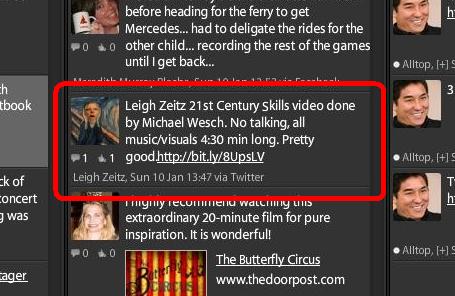
It didn’t take long to locate the information and send back the advice. After sending it, I began thinking about all of the skills that I was using in the hunt. I didn't have much time to think, because shortly after sending the message, my thoughts were interrupted by the ding from TweetDeck with a Facebook update from Leigh Zeitz via Twitter.

It was a link to a video about 21st Century Skills. When I visited the site, I immediately recognized the music as that which Michael Wesch had used in the Machine is Us/ing Us. As I watched, I was sure it was a new Michael Wesch video, and I realized that my thoughts had not been interrupted, they have been expanded upon by the video I was watching. WOW!

As the movie came to an end, I was pleasently surprised to find that it wasn't Michael Wesch, but the Weymouth High School social studies department who had been inspired by Wesch’s video. WOW!

Then something caught my eye. The video had been posted to YouTube as a response to another video, Curriculum 2.0. As I watched this, I began to get that Powers of Ten feeling. It was like mentally taking a step back and seeing a great deal more. A universe of connections powered by 21st century skills was unfolding in my mine and in front of my eyes. WOW!

Then for some reason, I went to The Machine is Us/ing Us for about the 100th time, this time I noticed the version I was watching was a video response, or in this case an update to an earlier version, which was a response to the Web 2.0 video. WOW!

Web 2.0 - 523,269 views
The Machine is Us/ing Us V.1 - 10,728,239 views
The Machine is Us/ing Us V.2 - 1,174,007
21st Century Skills - 6,249 views

That's almost 12 million views on YouTube alone. There's no way to tell how many other viewings took place around the web. WOW!

But why aren't we translating what we see here into our every day practice? Maybe it's because we still have to catch up to The Evolution of Dance and its 134,417,368 YouTube views. OW!

Tuesday, December 29, 2009

A Wake Up Call


Scott McLeod posted his presentation to the NEA as a slide show and an audio file, on his Dangerously Irrelevant blog.

Since he graciously licenses he work under creative commons, I took the liberty of using Adobe Presenter to sync the audio to the slides.

If I might sum up his message to the NEA and education in general, I would say, WAKE UP! But then again, that has been his message, my message, and the message of many others for years. I honestly think people are starting to listen, but listening is still a long way from acting.

If you want to see and hear his presentation, click on the picture above or here.

Monday, June 1, 2009

The World is Moving Too Fast for Education!

File this one under the old joke, "The faster I go the behinder I get." We are still struggling to get schools into the Web 2.0 world and now Google comes along with Wave, a new, amazing, collaborative, OPEN SOURCE product that adds a mountain of promise for the world and ocean of challenges for education.

Later this year Google Wave will be going live. It is like Facebook meets email, meets IM, meets Flickr, meets blogging, meets Google docs, meets wikis, meets Twitter, meet Survey Monkey, meets.... (Are you getting the idea?)


http://www.youtube.com/watch?v=v_UyVmITiYQ

Do you have technophobes in your district? We all know that there is little chance of getting them to change. How about showing this demo at a faculty meeting and telling the staff you want students to begin using it. The fun will start as their eyes begin to glaze over. Then the heads will go down, there will be gnashing of teeth, crying, and wailing. They won't change, but they will run from the meeting, pulling out their hair, and screaming about filing for retirement.

But wait! They will be back as soon as they realize that with filtering and blocking, it's not going to happen.

Sunday, April 13, 2008

Can I Get a Doctor Here!

Ok, it's time for some no BS talk. I'll begin by making it clear
that the opinion about the state or educational technology and
Internet safety education are my opinions and not necessarily those
of WiredSafety.

Thirty-eight years ago I was a new teacher sitting in classroom with fifteen other new teachers. The then Superintendent of Rockaway Schools, Bob Linette, was conducting the class and asked us one by one what we thought of the American educational system. One by one each person sung the praises of our system. I was the last to reply and when he asked me, I said it stunk. The silence and looks on the faces of the other fourteen people said volumes.

Without pausing, he asked me to explain. I asked him and the group what part of their day was the math part, what part was the science part, what part was the social studies part? I said we were supposed to be teaching kids about life and how to success. I failed to see how this achieved that goal. I felt that school should be more like life, that kids should be solving real world problem and doing real world work. When I was done, he just said, "You're absolutely right."

Those three words set the course of my career and from that day on, I never looked back. Ever since then I've been trying to get schools to change the way they deliver instruction. It's thirty-eight years later and things have changed very little. Yes, technology is now in the picture, but technology implementation without changing how we deliver instruction is not going to work. In many ways technology has worsened the situation. There was already disconnect between curriculum and the skills that the 20th and 21st century required. With kids knowing more about technology than the teachers, the gap became a chasm.

As a result, the state of educational technology infusion in this country is a shambles. I'm not talking about the cables, routers, and computers. They are nothing to brag about, but compared to the hardware, the effective implementation of technology is in such a state that if it was in an episode of M.A.S.H., it would be on a gurney, with Hawkey and BJ doing everything they can do to keep it alive as it was heading for the operating room.

Lack of visionary leadership, lack of technical support, lack of professional development, budget constraints, NCLB, pressure to perform on high stakes tests that measure all the wrong things, and other mandates that hamstring teachers, make them little more than paper shufflers and test tutors. Yes, there are pockets of excellence. There are exemplary schools and programs, and there success stories, but they are the exception rather than the rule.

I've spent the last ten years of my life trying to make a difference in this arena. Now I've retired from that life and have perhaps jumped from the frying pan into the fire. I'm attempting to develop Internet safety instruction that schools can use.

If you believe what I say about the state of educational technology in this country, then it isn't a stretch to realize that the state of Internet safety education is in worse shape. If teachers don't have the time or expertise to implement effective use of technology in the core curriculum, expecting them to implement Internet Safety instruction is total folly. It's like strapping a couch to the back of a sprinter and asking him to run a marathon.

I'm not sure if it's because I'm an optimistic masochist or because I graduated from Rube Goldberg High School and McGuyver High School, but I liked the challenge. Two years ago I started a program that I felt dealt with both problems at the same time. I coined the phrase
and began my program of CyberSafety through Information Literacy. It was a series of lessons that could serve both as professional development for teachers and Internet safety instruction for students. The lessons are aligned to the National EducationTechnology Standards and other core curriculum standards. Instead of being add-on curriculum, it could be integrated into the existing curriculum in a number of ways.

Inexperienced teachers could run the Flash based lessons and let me provide the instruction. Because the software allows teachers to control all phases of the presentation, including sound and sequence, as inexperienced teacher became more comfortable with the material,
they could make it their own by substituting their narrative for my audio tack and by selecting what to present and when to present it.

Now I think it's time to take the next logical step. We at WiredSafety have found that two of the most effective tools for getting teens to listen to our message is to have it delivered by other teens and to have the message wrapped around real stories about real people and real events. Our Teenangels have stories of their own that they relate. You can find out more about them by visiting Teenangels.org.

We at WiredSafety have stories activities and suggestions that we relate to parents, teachers, and teens in our presentations. Some of those stories are already contained in my CyberSafety through Information Literacy lessons. Over the coming weeks and months, I'm going to begin extracting those stories, add new ones, offer short suggested actions and activities, and create a library of 5-10 minute learning objects that teachers and parents can use whenever they have
time or whenever they see a teachable moment.

I'll blog about them here and post them on the WiredSafety site. As they begin appearing, I welcome your comments, questions, and suggestions.

Maybe together we can help Hawkeye and BJ get a patient off the critical list.

Wednesday, February 27, 2008

Technology Workshops Can Be Heaven or Hell

Today I did a Web 2.0 in Education workshop for a small group of teachers in Absegami High School in South Jersey. It was NOT what I had expected.

When they originally asked me to do the workshop we discussed the fact that there might be a lot of material that might be blocked and that we needed to make sure that some of the key sites we were using would be open. The person I spoke to confirmed my fears and said that many of the teachers complained about the amount of blocking that takes place. Having done workshops around the country, I have come to see this as the norm. My expectations were set by my past experiences and while I loved the idea that they were asking for a workshop that pushed boundaries, I was a bit apprehensive.

About a week before the workshop, I sent her 7 URLs and asked her test them. I had about 30 others that we would be using, but felt that these 7 were important. I could live with blockage of the others. Based on workshops that I had given in the past, I expected that no less than two would be blocked. I was pleasantly surprised when she said that only Ning was blocked, but that she had put in a request to have it unblocked. Wow, they have an unblocking procedure that people actually use!

I learned a long time ago that when I do workshops that push technical limits or even challenge the status quo that I had better have plans A, B, C, and D in place and hope that I don't have to go to plan E. To make a long story short, I was able to go with plan A. (See me do a happy dance.)

The first thing I did was to show up an hour early so that I could test everything ahead of time. I came prepared with my material on CD, two different thumb drives, a copy that I could access online, and a copy on my own laptop. I logged in with the temporary login they gave for trainers, popped in the CD, and tried to drag the folder to the desktop, but it wouldn't let me do it. I did a quick check of My Computer, found the network directory assigned to login and dropped it there. Nice housekeeping!

The first thing I noticed was that I there weren't any speakers for my computer. I called down to the office and in 5 minutes I had two people hooking me up with speakers. During the five minutes I was waiting, I printed out a document I had forgotten to print ahead of time. The printer was on and ready for me, not something to be taken for granted.

Next I opened my presentation and began checking the links one by one. Ning was opened as per her request and the only sites that were blocked were 3 sites that expected to be blocked and would have been shocked if they were not. They were YouTube, SecondLife and Teen SecondLife. Imbee was also blocked, but that's not surprising in the least. In talking with one of the folks hooking me up with speakers, he made it clear that they try to be as responsive as possible to unblocking requests and that YouTube is often unblocked for periods of time for teacher requesting its use. Kudos to the techs and those who put the policy in place!

Ok, I was set, but how would things be for the teachers? There were about 25 computers in the lab, most of which were in sleep mode. I woke up the sleepers and turned on the others. Every mouse was functioning and only one computer failed to boot. Impressive!

I had done all of my testing and had lots of time before the workshop, so I headed to the teachers lounge. Things just kept getting better. I found vending machines with a nice selection of drinks and goodies. Not only did the machines accept my rumpled $1 bills, but the selections I wanted were in stock and fresh. Yum!

When the participants arrived, I had them go online to a survey I had posted to an Adobe Connect server. They took the survey which gave me their wants and set the priorities for the workshop. Then I asked the group how many of them felt that there were too many things blocked by their network. They were unanimous in their agreement that too much was blocked.

At that point, I let them know that I have had the good fortune of having given workshops all around the country and that they had one of the best run and most open networks I had come across. I told them that most teachers would be overjoyed to have the access that they had, but that their complaints are no less valid than the others. The more you use the technology the more access you need. The fact that they were complaining about their access told me that they WERE using the technology. That was further supported by the fact that never once throughout the entire workshop did I have to stop to assist anyone with basic technology skills. What a joy to be able to teach instead of being tech support!

One little anecdote that might give you some feeling for this group centered around our discussion of Wikipedia as a good starting point, but with the need for additional citations. One gentleman said that he and his students were aware of the problems with accuracy, but allows Wikipedia as the only citation. I was a little puzzled. It was not typical behavior to embrace Wikipedia so wholeheartedly. I asked him to explain why. He said that it's very convenient and he only uses it when he wants students to understand a general concept or the significance of the contribution of a particular person. I then asked him what subject he taught. He told me "wood shop".

No way I can argue with his logic. Outstanding and clearly not typical!

I could list a half dozen other incidents that told me folks were doing things right. Such as the fact that we had 15 minutes left at the end and no one left early. Everyone was visiting sites we had discussed and about half of them were constructing their iGoogle pages which I had introduced as a way to get them started moving to the Web 2.0 world.

Having a small group is hardly basis for judging the performance of an entire staff, but if they were representative of what is going on in the district, Absegami is doing things right.

I left the building with a smile on my face, more refreshed and exhilerated than when I had started it and decided to go another 40 minutes out of my to head to Atlantic City to treat myself and my wife to a White House steak sub!

I want to passed on my observations and compliments to the teachers, tech staff, and administrators in the district and I want more workshops like this one!

Wednesday, February 20, 2008

Web 2.0 in Education

Next week I'll be doing a Web 2.0 in Education workshop for Absegami High School. Here's a quick peek at some of the sites we will be visiting and discussing. This trailer was created using a new Web 2.0 beta called Animoto.